
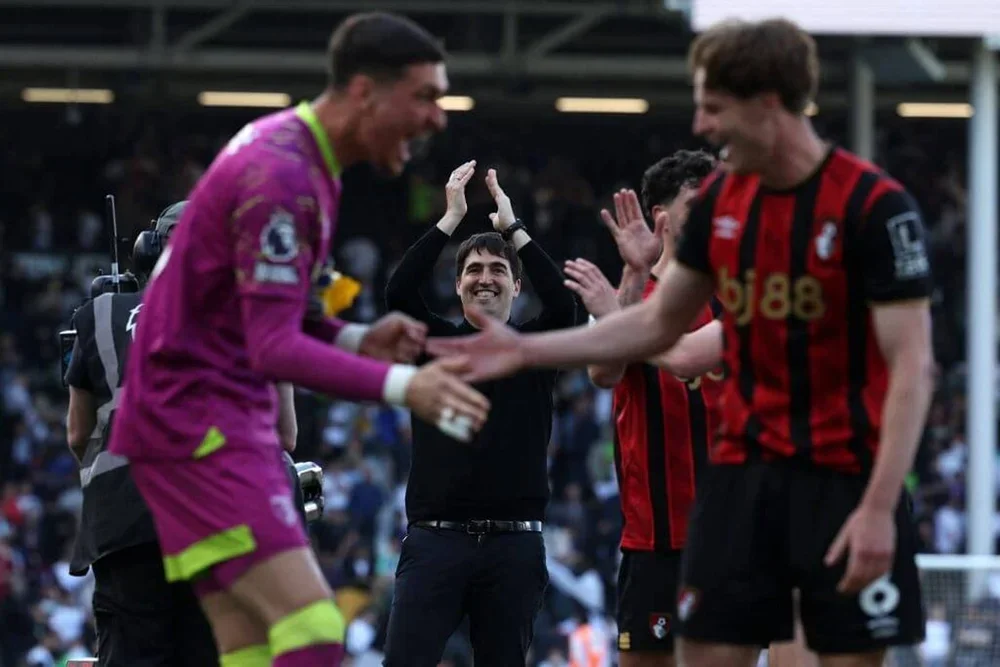
Andoni Iraola applauds the fans as Bournemouth players celebrate their victory at Fulham.
By Conor O’Neill
In January, Bournemouth faced a bleak outlook. They sat 15th in the Premier League table, had just sold star forward Antoine Semenyo to Manchester City for £62.5 million ($85.2 million), and manager Andoni Iraola’s contract was set to expire in the summer. Uncertainty loomed. How would they respond? By embarking on a remarkable 16-game unbeaten run in the league.
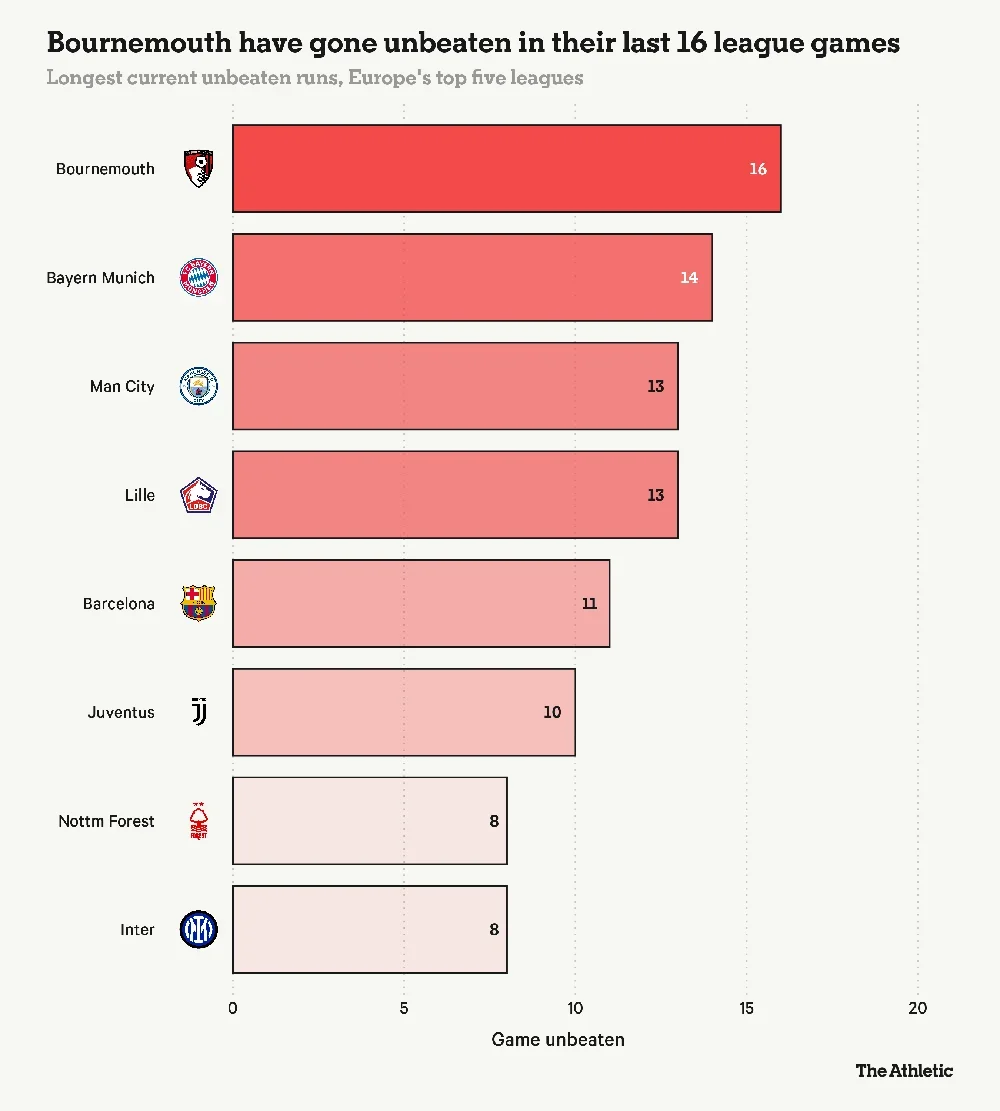
After a 1-0 away victory against Fulham on Saturday, Bournemouth now hold the longest unbeaten streak across Europe’s top five leagues. They climbed to sixth place, within reach of a historic first qualification for European football.
The resurgence was sparked by Semenyo himself, who scored a stoppage-time winner in a 3-2 home victory over Tottenham Hotspur in what turned out to be his final game for the club. That goal ended an 11-game winless streak and ignited the unbeaten run. Fifteen matches later, his replacement, Rayan, sealed the victory at Craven Cottage with the decisive goal.
That Rayan scored felt fitting. The Brazilian winger embodies the cycle of renewal that Bournemouth have skillfully managed in recent seasons. Under Iraola, the club has built a reputation as a finishing school for elite talent, attracting and developing players before bigger clubs inevitably come calling.
Last summer, three-quarters of Bournemouth’s back four were poached by Europe’s elite: Dean Huijsen, Milos Kerkez, and Illia Zabarnyi secured big-money moves to Real Madrid, Liverpool, and Paris Saint-Germain, respectively. Winger Dango Ouattara was signed by Brentford for £42.5 million.
Iraola acknowledged that such turnover each season is inevitable, but noted the disruption it causes, especially for a finely tuned system like Bournemouth’s, which relies on coordinated pressing. The scale of the upheaval is evident in the graphic below, which shows how the share of playing minutes has shifted since last season. Bournemouth’s figure stands at 63.6 percent, with only promoted Sunderland having a higher rate of squad change.
“We are in a process that will take time,” Iraola said before a 4-1 defeat at Brentford in December, the low point of their mid-season slump. “We have changed a lot. We have sold and bought many players, and they are adapting at different rates. The process is still ongoing.”
The timeline has accelerated. The rolling expected goals-for-and-against graphic below shows that Bournemouth have routinely out-created opponents since shortly before the unbeaten run began. The transformation is stark. Before the streak, they conceded 1.9 goals per game, the third-worst record in the league. Since then, only two teams have a better defensive record, conceding just 0.88 goals per game. While fewer goals are conceded, the underlying defensive numbers haven’t changed drastically; earlier in the season, Iraola lamented inefficiency, but now they are more effective at preventing chances from becoming goals. At the other end, both goals and expected goals have risen, pointing to a more cohesive and potent attack.
Part of the improvement stems from new signings adapting to Iraola’s system.